


Search Results for Tag: Philippines
A hot ride in Manila
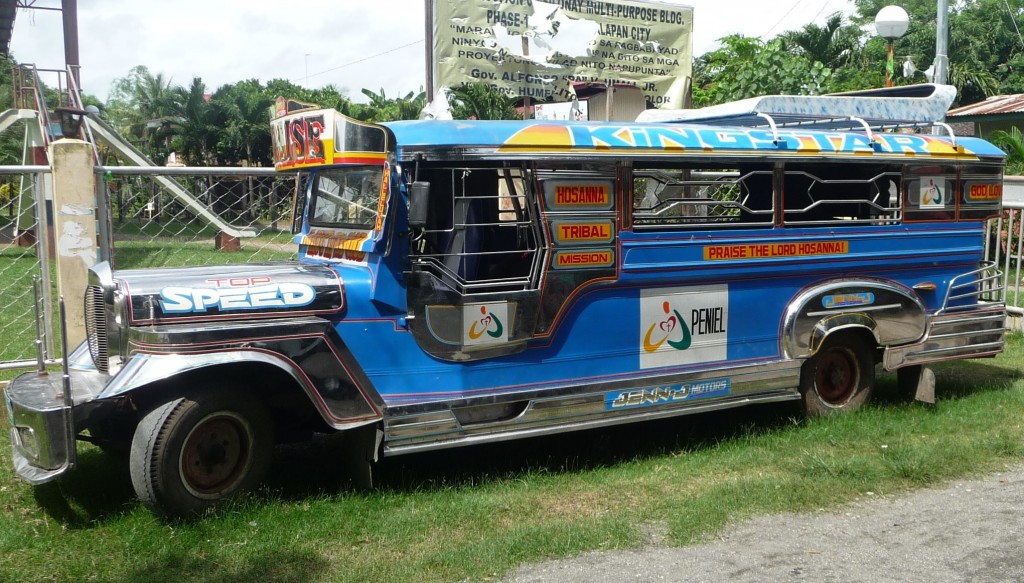 If someone has to use public transport in Manila, people most likely go by Jeepney. It‘s a typical Philippine transportation. Sometimes it’s extremely crowded, people squeeze in there like sardines in a can if they have to travel from one to another location. Most of all, the Jeepney is a damn hot ride, especially from an outer perspective. Each one of them is painted in a different way, very often with Christian blessings or something that is kind of a job description of the car‘s owner, „banana dealer“ for example. Some of the custom bodies are decorated with sculpturs, so it‘s possible to meet four big horses sitting on a something that‘s acctually a public transport vehicle. Fantasy has no borders, right?
And the number of Jeepneys in Manila is epic. Watching them drive by in the city sometimes feels like visiting a huge street art gallery.
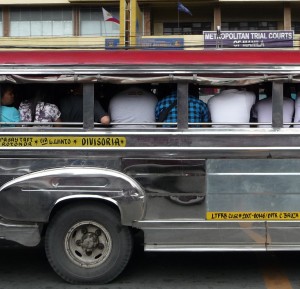 Historically Jeepneys were American army jeeps left over from Wolrd War II. The word comes from a combination of the words “jeep” and “jitney” – which is something like a cab or bus carrying passengers on a regular route with flexible schedule. Today they are produced on a regular basis.
But: As nice as Jeepney‘s may look the bad they are for the environment, guzzling an amazing lot of gas. So the gouvernment thinks about to at least lower the number of Jeepneys cruising the streets. That good for the environment of course, but it‘s sad for the eye.


Green Advertising

Have you heard about the new Coca Cola billboard in the Philippines? The famous soft-drink company teamed up with the World Wildlife Fund to create a huge, environmentally-friendly billboard that’s actually alive!
It’s made up of 3,600 small tea plants that suck in harmful air pollutants from the surrounding atmosphere, and the plants themselves are placed in pots made of recycled Coke bottles.
What do you think? Is this an effective way of raising awareness and saving the planet?
One official from the project says the billboard can soak up 46,800 pounds of CO2 – especially important in the Philippines, where air pollution is a big problem.
 Comments deactivated
 Disaster and climate science – the story of Mt Pinatubo
This is a post-script to the blog entries from the Philippines by our reporter Carl Gierstorfer:
On my last day before returning to Berlin, I climbed Mount Pinatubo. Or rather what's left of Mount Pinatubo. Because in June 1991 a series of volcanic eruptions blew the top 160 meters off this mountain. A cloud of volcanic ash rose some 34 kilometers into the Earth's atmosphere (here is some more information and a picture from space, taken by the orbiting Shuttle crew). The evil twist in Pinatubo's eruption was that it coincided with a typhoon sweeping over Luzon Island. The heavy rains washed out much of the ash and deposited it over a wide area. Mudslides, called Lahars, destroyed villages and left 700 people dead. Large parts of this rice granary of the Philippines were covered in sediments up to one meter high. Probably worst hit were the indigenous Aeta people who used to live on the slopes of Mt Pinatubo. Although they managed to flee before the eruption, their habitat was destroyed; they were resettled in refugee camps, where many ended up as beggars and alcoholics.
The eruption had quite a dramatic effect on the world's climate. The following winter was unusually warm in the Northern hemisphere, while the Near East saw snow and corals died of cold shock in the Red Sea. For scientists these climate anomalies were a unique chance to calibrate their models against reality.
This is a short video I shot of the Pinatubo crater lake. What once must have been the most hostile spot on this planet is today a strangely tranquil and peaceful place. But don't be mistaken: Pinatubo is just sleeping as the bubbles of sulphuric gas and spots of hot water remind us. Enjoy.
Comments deactivated Meet the first GLOBAL IDEAS ambassador
At the end of his filming trip to the Philippines, our reporter Carl Gierstorfer talked to one of our first GLOBAL IDEAS ambassadors. Read Carl's final dispatch from Manila:
"Meet Eric Raymundo, an engineer and environmental practitioner here in the Philippines. Eric caught our attention because he is such an enthusiastic follower of the Global Ideas project. Eric's enthusiasm is rooted in his deep concern for nature and a sustainable way of living. A former scuba diver, Eric now consults businesses in the Philippines on how to save energy and resources; eventually he wants to build a network of zero carbon tourism resorts in the Philippines. His work is part of the Switch-Asia project, funded by the European commission and carried out in collaboration with the Center for Appropriate Technology at Vienna University of Technology.
In this little movie you will hear about Eric's realistic approach to getting things done; his concerns about global warming and his idea for a cooler world. Enjoy."
Comments deactivated Abandoned wonders
Our reporter Carl Gierstorfer has finished filming for his upcoming report on sustainable rice crops in the Philippines. Read his latest post from the field:
"The Filipinos call them the 8th world wonder, UNESCO lists them as a world heritage site: the rice terraces of the Cordillera mountains in northern Luzon. The Ifugao people started to carve them into the hillsides 2000 years ago, at a time when iron hadn't been discovered in their part of the world. Instead they used hardwoods collected in the forests; they built complex irrigation systems and transformed these mountainous forests into a rice growing region.
One cannot stop wondering about why the Ifugao people, apparently feared headhunters, took so much effort to grow rice. Were the forests hunted empty? Was it prestigious to grow rice? What's for sure is that the climate here, even in the present cooler and drier season, is not pleasant. It's damp, wet, and pretty cold at night. The terraces are still farmed today, the plots of land handed down the generations. It is tough work. During the rainy season landslides destroy many rice paddies. Small wonder, then, that more and more of the fields are being abandoned; young people move to the cities, get jobs in the tourism industry. After all, it takes almost a year's work to harvest rice that will last for only a few months. As spectacular as these rice terraces are, there is nothing romantic about farming them. One can only hope that after 2000 years there will be at least some people left who will maintain this 8th wonder of the world.
We have finished filming and head back to Manila. There is lots of material – so now it's all about choosing the most interesting bits for the report."
Comments deactivated 


Feedback